| Award | Intake | Duration |
|---|---|---|
| BA (Hons) Business and Tourism Management with Foundation Year | September Intake | 4 Years Full-Time |
| Learning Mode | Campus location | Awarding Institution |
| On Campus | Leicester Campus | University of Wolverhampton |
Please contact the admissions team for the latest tuition fee information, funding eligibility, and available financial support options.
Flexible payment plans and student finance guidance may be available for eligible applicants.
Visit our Fees and Funding page for more information on the funding that you may be eligible for.
Prepare for Foundation Pathway:-
We will consider applicants who have not achieved level 3 qualifications, if you have a keen interest in this subject area or hold relevant experience.
You will be required to attend and pass a compulsory Prepare For Foundation assessment day where you will take part in a variety of activities which will assess your suitability for the course.
If you would like more advice and guidance about this admissions pathway, please contact the SIRM Admission team to discuss and support you in making an application to us.
Other Requirements: Applicants must be 18 years old or above at the start of the course.
We also consider applications from mature students who do not have two years of post-16 study, where they have relevant work experience. Please seehttp://wlv.ac.uk/mature for further information.
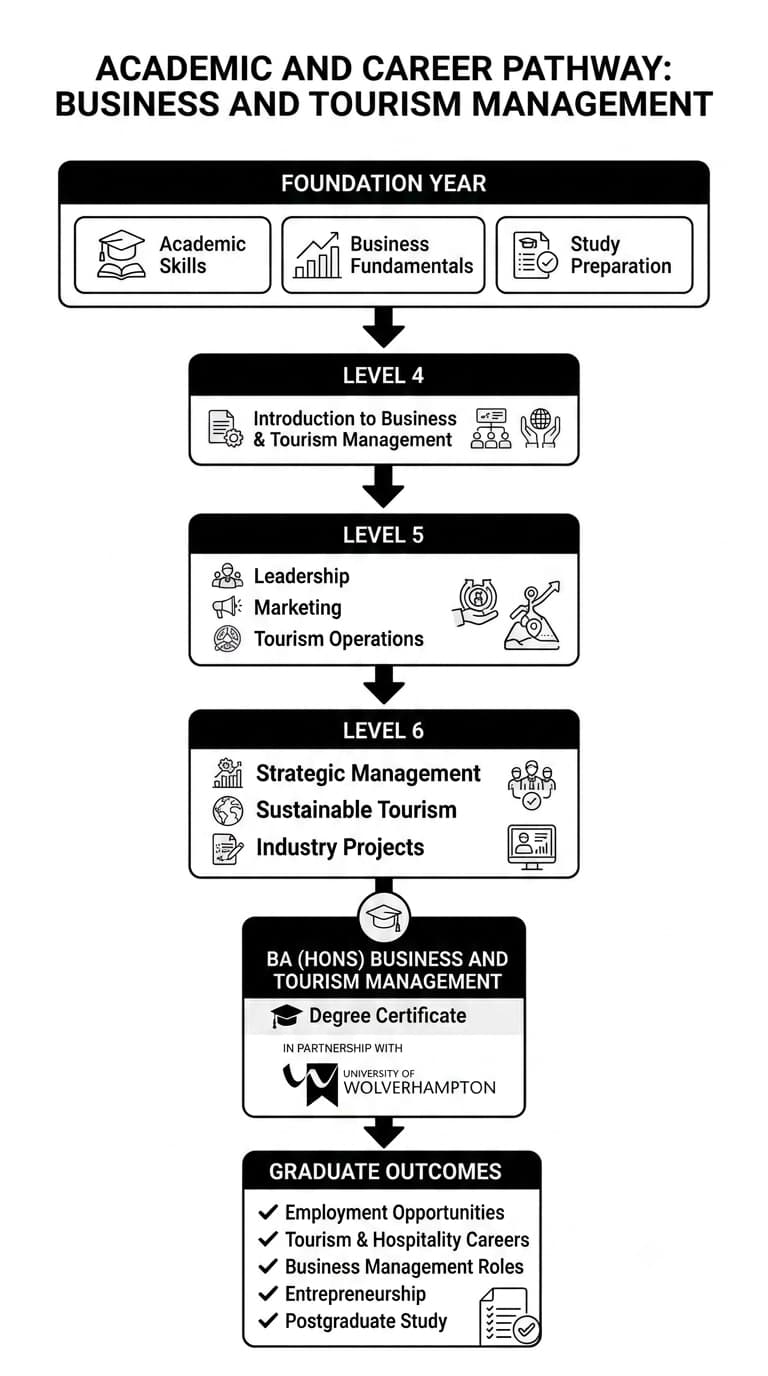
The course combines business management with the rapidly evolving tourism and visitor economy, helping students develop commercial awareness, leadership, digital capability and sustainable business practices through real-world case studies and industry-focused learning. Graduates leave with transferable skills suitable for careers across a wide range of business, tourism and service industries.
The Foundation Year provides an inclusive and supportive pathway for students who benefit from additional academic preparation before Level 4 study. It develops academic capability alongside business and tourism knowledge through modules focused on academic success, business principles, digital citizenship and leadership. Students build confidence in critical thinking, communication, digital literacy and professional awareness while exploring contemporary business, tourism and global perspectives. The curriculum integrates knowledge, skills and professional identity to prepare students for successful progression into the undergraduate programme and future employment.
Students progress through a structured learning journey beginning with academic preparation and progressing into business and tourism management, entrepreneurship, digital business, destination marketing, sustainability, analytics and a professional project. Full module details should be presented using the approved University module listing for partner delivery.
Module: 3GK023
Credits: 30
Period: 1
Type: Core
This module focuses on the role and responsibilities of people working for themselves, or in organisations, situated within real world business contexts. This module will provide you with an introduction to leadership and management concepts, where you will explore the dynamic external and internal factors that influence organisational success. Alongside these core concepts, you will define and explore definitions of, and essential management functions that contribute to effective leadership. A significant focus is placed on developing your academic and digital skills through the practical application of knowledge to real world business leadership and management case studies. You will learn to research, structure, and construct a case analysis using appropriate digital tools. Finally, a critical component of the module involves self-reflection encouraging you to assess your strengths, identify areas for development, and align these insights with potential roles and career in business and management.
This module will introduce you to the university environment and you will explore strategies for successful university-level study. You will be encouraged to explore your course and how it will support your future career aspirations. Throughout the module, you will establish your own personal development plan (PDP), identifying your personal strengths and areas for development, and setting targets to promote your academic and personal development and develop the resilience needed to achieve your goals. The second part of the module will introduce you to the wide variety of academic skills needed to succeed at university and enable you to develop and apply these skills. This will include: 1. how to write in an academic style, 2. how to structure essays and reports, 3. reading for academic purposes, 4. referencing skills. By the end of the module, you will have a clear understanding of the craft of academic writing and the standard of written work expected at university.
This module provides you with an introduction to the wider environment in which contemporary businesses operate. You will examine current debates concerning the purpose and management of modern organisations and develop an understanding of how businesses function. The module explores key internal and external aspects of organisational activity, including Operations Management, Marketing, Financial Information and Human Resource Management.
This module introduces you to the foundations of enterprise and entrepreneurship, exploring what it means for individuals to think entrepreneurially and for businesses to act in an enterprising way. You will examine key theories and perspectives on creativity, innovation and enterprise, developing an understanding of how these ideas shape opportunities and drive success. You will be encouraged to question where ideas come from, how they are generated and the role of different people in turning ideas into reality. Through interactive activities and discussions, you will explore practical tools and approaches that help identify, develop and implement new ideas. By the end of the module, you will not only have gained knowledge of the essentials of enterprise and entrepreneurship but also gain confidence in applying them to your own studies, career ambitions and wider experiences. This will provide you with a solid foundation for further learning in entrepreneurship, innovation and business management at higher levels of study. The module uses globally relevant examples and activities so that students from a range of cultural and professional backgrounds can see the value and applicability of entrepreneurial thinking in their own contexts.
This module introduces you to the fast-moving world of digital business and how technology is transforming the way organisations operate, compete, and grow. You will explore key concepts such as digital transformation, innovation, and business models, and learn how digital capabilities like cloud computing, AI, and blockchain are reshaping industries. During the module you will gain insight into how businesses use digital tools to create value, improve customer experiences, and stay ahead of competitors. You will examine enterprise systems, information management, and understand how big data and business intelligence drive smarter decision-making. Legal, ethical, and regulatory issues will also be covered, helping you think critically about the risks and responsibilities of operating in a digital environment. This module blends theory with practical examples, giving you a strong foundation in digital business transformation, strategy and systems thinking. Whether you’re aiming for a career in business, marketing, technology, or entrepreneurship, you will leave with the skills and confidence to navigate the digital landscape and contribute to innovation in any organisation
This extended induction module supports your transition into university life and introduces you to the requirements of academic skills. It helps you build confidence, develop a strong academic identity, and understand the expectations of university study. You’ll explore key academic practices including independent learning, digital literacy, and ethical academic conduct—such as referencing, plagiarism awareness, and the responsible use of artificial intelligence in line with university policy. You will also be introduced to some of the tools and databases relevant for your studies. The module is structured around seven themes identified by students as essential to their university experience: Ready to Study: Clear guidance on expectations, transitions, and workload planning. Academic Skills and Educational Gain: Development of foundational academic skills including time management, critical thinking, and digital fluency. Career Readiness and Professional Identity: Early exploration of career pathways, CV building, and professional behaviours. Personal Development and Belonging: Activities that foster confidence, inclusion, and identity within the university community. Social Engagement and Community Building: Opportunities to connect with peers, staff, and wider university life. Feedback and Reflective Practice: Structured opportunities to receive, apply, and reflect on feedback to support growth. Wellbeing and Student Support: Embedded access to holistic support services and strategies for success. This module lays the foundation for future development, including the Level 5 Professional Development module/embedded placement experiences.
This module introduces you to the dynamic world of tourism, travel, and culture, helping you understand how destinations develop, attract visitors, and respond to global challenges. You will explore the foundations of the tourism industry and learn how destinations are shaped by cultural, social, economic, and environmental factors. Through lectures, workshops, and case studies, you will apply key tourism models such as Butler’s Tourism Area Life Cycle (TALC), the 4As framework, and push–pull motivation theory to real-world examples. You will also develop essential academic and professional skills, including research, analysis, and digital communication, which will prepare you for further study and careers in tourism and related sectors. Assessment is designed to reflect professional practice: you will complete an individual 15-minute pre-recorded presentation focused on a destination of your choice, analysing its tourism development, visitor motivations, and impacts. This task allows you to demonstrate your understanding of how destinations evolve and to practise presenting your ideas clearly and creatively. By the end of the module, you will have a strong foundation in tourism studies, an awareness of sustainability and cultural diversity, and the confidence to apply theory to real-world tourism contexts.
This module explores how destinations are marketed in an increasingly competitive, global tourism environment. You will examine how places such as cities, islands, and regions build their identities and attract visitors through branding, promotion, and storytelling. The module introduces key marketing concepts and tools used in tourism, including market segmentation, positioning, branding, and campaign development. Through real-world examples and current industry case studies, you will analyse how destinations communicate their unique selling propositions and how external factors—such as sustainability, technology, and cultural trends—shape marketing decisions. You will also develop creative and strategic thinking skills by designing your own marketing recommendations for a chosen destination. Assessment is designed to reflect professional practice. You will produce a Destination Marketing Vlog, showcasing your analysis and creative ideas, and an Academic Poster summarising your research and strategic proposal. This combination helps you build confidence in presenting your ideas visually and verbally while strengthening your understanding of destination marketing in theory and practice. By the end of this module, you will be able to apply marketing principles to real destinations, evaluate campaigns critically, and develop innovative strategies for future tourism success.
This module introduces you to key ideas and current topics in leisure research. You will explore how different researchers study leisure, why it matters in today’s world, and what we can learn from their work. The module is flexible, so new trends and issues in leisure can be added as they develop. Together, we will look at examples from different places and cultures to understand how leisure connects to people’s lives locally and globally. You will take part in discussions, read current studies, and reflect on how research helps us understand the role of leisure in society. By the end of the module, you will feel more confident reading and interpreting leisure research and will be able to apply this understanding to your own area of interest.
This module develops your understanding of how organisations design, manage, and improve operations and supply chains, while also introducing core principles of project management. You will learn key operational concepts such as process efficiency, capacity planning, lean management, and sourcing strategies. You will apply project planning tools, including Gantt charts, stakeholder analyses, critical path analysis, and risk registers, to plan and evaluate real or simulated projects. Through practical group activities, you will build teamwork, negotiation, and communication skills essential for managing performance and coordinating across functions. The module also encourages you to reflect on the professional behaviours required in project and operations environments, including accountability, adaptability, collaboration, and ethical decision-making. By the end of the module, you will be able to analyse operational challenges, propose improvements, and plan and manage projects that balance stakeholder expectations, sustainability considerations, and organisational goals.
This module builds on the foundational skills and reflective practices introduced in the Level 4 'Succeeding at University' module, supporting students to deepen their professional identity and career readiness. It is designed to support students in developing the knowledge, skills, and reflective practices essential for continuous professional growth in a dynamic and evolving workplace. Through a mix of practical experience and professional development sessions, this module will enable students to explore essential themes such as personal effectiveness, leadership, communication, ethical practice, and lifelong learning. Drawing directly from work experience and/or professional setting, students will reflect on their real-world experiences to deepen their understanding of what it means to grow and succeed in their chosen field. Students may draw on case studies or sector examples to connect theory to practice. Students will engage in self-assessment, goal setting, and action planning to identify their strengths and areas for development. The module emphasizes reflective practice as a tool for professional learning and encourages learners to critically evaluate their experiences and performance in real-world contexts. Specialist professional knowledge areas aligned with the expectations of the Institute of Hospitality and the Institute of Travel & Tourism are embedded throughout the module in relation to relevant career pathways. This enables students to begin aligning their personal skills, professional behaviours, and reflective practices with sector-recognised professional standards. Formalised continuing professional development (CPD) planning supports students in taking ownership of their learning and professional identity, enhancing employability and supporting progression within hospitality, tourism, and related service industries.
This module gives you the skills to turn data into powerful business insights. You’ll explore how organisations use analytics and intelligence to make smarter decisions, improve performance, and stay competitive. Starting with the basics of information systems and business analytics, you’ll build up to advanced techniques like predictive modelling, artificial intelligence, and decision support. You will learn how data is collected, integrated, and stored through data warehousing, and how to evaluate Business Intelligence platforms and architectures. We will also consider the ethical and legal issues around data use, and how to manage analytics systems responsibly. By the end of the module, you will be able to design analytics strategies, apply descriptive, predictive, and prescriptive techniques, and understand the future of analytics in business. You’ll use real-world examples and case studies to connect theory with practice, preparing you for roles in data-driven decision-making. Whether you’re aiming for a career in business management, marketing, business intelligence, business analytics, or strategic planning, this module equips you with the tools to lead with insight.
The module critically explores the challenges and opportunities of creating sustainable futures within the global tourism and hospitality industries. It addresses the environmental, social, and economic challenges facing tourism and hospitality and evaluates the strategies, policies, and innovations that can support a transition towards more responsible and resilient futures. The module encourages you to analyse the impacts of tourism and hospitality activities on communities, cultures, and ecosystems, while exploring approaches that balance commercial viability with ethical responsibility. You will engage with global sustainability frameworks, including the United Nations Sustainable Development Goals and consider their application to tourism destinations, hospitality operations, and wider supply chains. On completion of the module, you will be able to demonstrate a critical understanding of sustainability concepts and frameworks, evaluate the effectiveness of current practices, and articulate strategic proposals for advancing sustainable futures in tourism and hospitality.
This ultimate module provides students with the opportunity to undertake an independent study that blends learning from previous subjects. It is designed to showcase individual strengths and apply advanced knowledge to a practical business context. Students will create a professional business project that demonstrates their ability to address real-world challenges or opportunities. Emphasis is placed on critical thinking, problem-solving, research planning, data analysis and professional communication skills. By completing this module, students will demonstrate autonomy, innovation and the ability to integrate theory with practice - key attributes for advancing in professional and managerial roles.
This module critically explores the contemporary trends and emerging markets shaping the future of global tourism. You will examine how social, technological, economic, environmental, and political forces are transforming patterns of tourism demand and supply. This will include how technological innovation, demographic change, shifting consumer values and responsible tourism practices are transforming the structure and dynamics of the tourism industry. You will engage with current market intelligence data, case studies, and industry insights, to analyse patterns of growth in emerging markets and tourism regions across the globe. Emphasis is placed on understanding how destinations and organisations can anticipate and adapt to these evolving forces. By the end of the module, you will have developed the analytical and strategic skills to identify, interpret, and respond to emerging trends. You will be equipped to assess the potential of new tourism markets and to make informed, forward-thinking recommendations for organisations and destinations operating in an increasingly dynamic and interconnected global environment.
The course will provide the student with opportunities to advance their ICT skills through the use of application software and digital technologies. The diversity of topic areas covered in the study programme will allow students to develop their own understandings of collective responsibilities as global citizens within their local, national, and international communities.
The course provides an opportunity for the student to pursue a one-year work placement in employment, either in the UK or abroad. Support will provide to aid with the preparation of CVs, and workshops will available that support the completion of application forms and provide guidance on interview techniques.
Students who successfully complete the course are expected to enhance their job prospects and strengthen their employment opportunities. The course is designed to prepare students for career opportunities in a variety of tourism related areas including location marketing, green tourism development, and tourism research.
Everything you need to know about this course!
Teaching combines lectures, seminars, workshops, collaborative learning, case studies and online resources. Students engage with enquiry-based learning, digital tools, peer collaboration and practical activities that connect theory to contemporary business and tourism practice. Assessment includes reports, presentations, portfolios, reflective work, digital artefacts and case studies, with formative feedback, industry-relevant assessments and applied learning embedded throughout to build confidence, strengthen practical competence, and support academic success.
The course develops professional identity from the first year by embedding leadership, teamwork, ethical decision-making, customer experience, digital capability and strategic thinking throughout the curriculum. Students undertake practical projects, employer-focused activities and portfolio-based assessments that demonstrate workplace readiness. Professional, digital and intercultural skills are embedded throughout the course, preparing students to operate effectively across diverse workplace and cultural contexts. References to professional placements should be removed for partner delivery. Careers guidance, CV support, interview preparation and enterprise advice are available through SIRM College alongside University resources.
· Business Management
· Tourism Management
· Destination Marketing
· Hospitality and Visitor Economy
· Business Development
· Entrepreneurship
· Customer Experience
· Marketing and Management
· Events Management
· Destination Management
· Visitor Attractions
· Aviation and Cruise Management
· Police and Public Sector